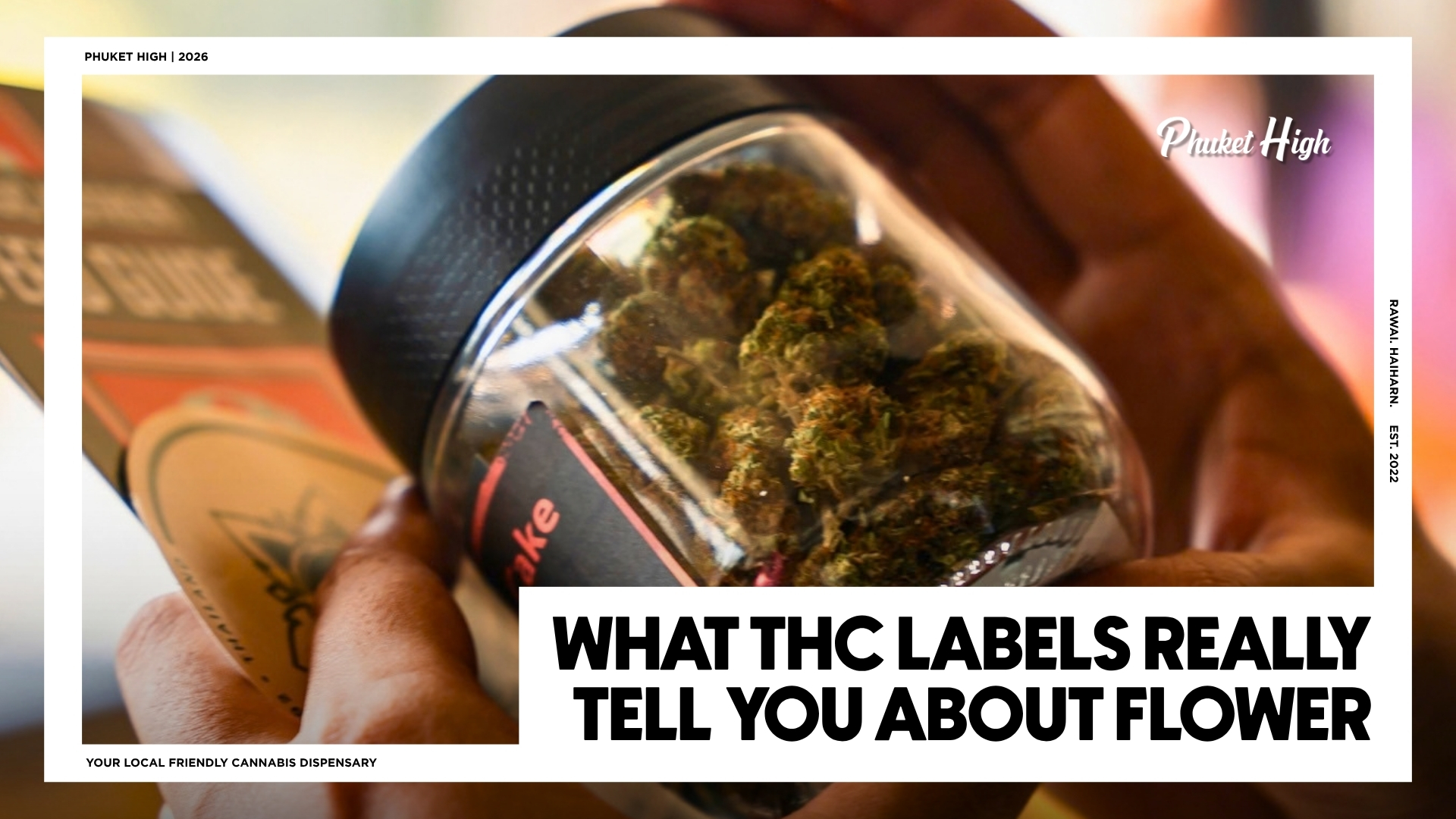
Walk up to almost any counter on this island and the first thing your eyes land on is a number. Twenty two percent. Twenty seven percent. Thirty one percent, written a little bigger than the rest, sometimes with a star next to it.
It is the most visible thing about a jar, so it is natural to treat it like a score. Higher number, better flower. That is how most people shop the first time.
It makes sense. Back home, a lot of visitors never got to see a number at all. Suddenly every Phuket dispensary is showing one, and it feels like the most important fact in the room. It feels scientific, and it is easy to compare one jar with the next.
The problem is that the number on the label is doing a lot less work than it looks like. It is not useless. It just does not answer the question most people think it answers.
So here is what a THC label is actually telling you, what it is quietly leaving out, and how to use it properly when you are buying weed in Phuket.
What the Number Is Actually Measuring
Start with the basics, because the basics are where most of the confusion comes from.
The percentage on a label is meant to show how much of the flower, by weight, is made up of THC. If a jar says 25 percent, the idea is that a quarter of that bud’s weight is the compound that gets you high.
Here is the first twist. Raw flower does not contain much THC at all. It mostly contains a related compound called THCA, which does not really get you high on its own. THCA only turns into THC when it is heated, which is exactly what happens when you light a joint or use a vaporiser.
So most labels are not showing you what is in the flower right now. They are showing you what could be there after heating. That is usually written as total THC.
How Total THC Gets Worked Out
There is a simple formula behind that total figure, and it is worth knowing because it explains why labels can look higher than you expect.
A 2025 study in Scientific Reports lays out the industry standard method. You take the amount of THCA, multiply it by 0.877, and add whatever small amount of THC was already there.
That 0.877 is not a fudge factor. When THCA is heated, it loses a small part of its structure as gas, so the finished compound weighs a little less than what you started with. The multiplier accounts for that lost weight.
The key word is theoretical. Total THC is the maximum you could get if every bit of THCA converted perfectly. In real life, some of it burns off, some stays behind, and how you smoke changes how much you actually take in.
So even a perfectly accurate label is describing a best case, not a guarantee.
Why Labels Are Not Always Accurate
This is the part most shoppers never hear about.
Researchers have tested this directly, and the results are not flattering. A 2023 study published in PLOS ONE bought flower from licensed shops in the United States and tested it independently. The measured potency came in, on average, 23.1 percent lower than the lowest number on the label. Around 70 percent of samples were more than 15 percent below what the label claimed.
The 2025 study found something similar. Only 56.7 percent of flower products landed within 15 percent of their labelled number, compared with 96 percent of concentrates.
Those studies looked at the US market, not Thailand, so they do not tell you anything specific about shelves here. What they do show is that the number on a jar is an estimate from one test, and estimates can drift. The PLOS ONE researchers pointed to things like inconsistent sampling, different lab methods, and the simple commercial pressure to print a bigger number, since bigger numbers sell.
That last point is worth sitting with. A high figure is good marketing. That alone is a reason to treat it as a starting point rather than the final word.
Why Flower Is Harder to Label Than Concentrates
It makes sense that flower is the trickier product once you think about it.
A bud is not uniform. The top of a plant, the part closest to the light, usually carries more resin than buds lower down. Two buds from the same plant, even the same branch, can test differently.
So when a lab tests a small sample and that result goes on a label for a whole batch, there is natural room for variation. The jar in front of you might hold buds that sit above or below the tested figure.
Concentrates are more mixed and consistent by nature, which is why they tend to match their labels more closely. Flower is a natural product, and natural products vary. That is not a flaw in any single shop. It is just how plants work.
What a High Number Does Not Tell You
Now for the bigger point. Even an accurate THC label only tells you about one thing.
It does not tell you how the flower will feel. Two jars with the same number can land completely differently, one leaving you relaxed and chatty, the other making you want to lie down. The experience depends on far more than a single figure.
It does not tell you about flavour or smell either. Aroma comes from other compounds in the plant, and a jar with a loud, specific smell often delivers a more enjoyable experience than a higher number with a flat, grassy one.
It does not tell you how fresh the flower is. A number from a test done months ago says nothing about how the jar has been stored since.
And it does not tell you how much you personally need. Someone who smokes a little on holiday needs a very different product from someone who smokes every day at home.
This is why regulars who have been buying weed in Phuket for years rarely mention the number first. Ask them about their favourite jar and they will describe the smell, the flavour and how it made them feel. The percentage comes up last, if at all.
Why Weed in Phuket Changes After It Is Tested
Here is something the label cannot show at all. Flower keeps changing after it is tested, especially here.
This island is hot and humid for most of the year. Heat and light slowly break down the good stuff in flower. Over time, THC can break down into a compound called CBN, which tends to feel heavier and sleepier rather than lifted. The PLOS ONE researchers actually checked for this breakdown when looking for reasons labels were off.
So weed in Phuket that tested at a certain number when it arrived may not be the same weed in Phuket sitting in the jar weeks later, if it has been kept somewhere warm or bright.
This is why storage matters so much. Sealed glass jars, humidity control and keeping flower out of direct sunlight all help it stay closer to what it was when it was tested. A label is a snapshot. Good storage is what keeps the snapshot honest for longer.
How a Good Phuket Dispensary Uses the Number
A well run Phuket dispensary treats THC as one piece of information, not the headline.
You can usually tell from how staff talk about it. Ask about a jar and a good budtender will tell you how it smells, how it feels, when it came in and who it suits. The percentage might come up, but it will not be the whole pitch.
A shop that leads with nothing but big numbers, pushing whatever tests highest, is often selling the label rather than the flower. That does not mean the flower is bad. It means you are not getting the full picture.
The best sign is a Phuket dispensary happy to steer you away from the highest number. If you say you are a light smoker and someone suggests something gentler instead of the strongest jar in the room, they are thinking about your night rather than the size of the sale.
Reading a Label Like a Regular
Once you know what the number means, reading a label gets easy.
First, check if it says THC or total THC. Most flower labels show total THC, which is the theoretical figure after heating. If a label lists THCA separately, you now know how the total was worked out.
Second, treat the number as a range, not an exact value. Based on the research, a flower label is best read as roughly this much, give or take.
Third, look past it. Smell the jar. Ask when it arrived. Ask how it feels. Those answers tell you more about the experience than the percentage alone.
Fourth, think about yourself. A modest number is often the better choice, especially on holiday when heat, travel and a couple of drinks can all make flower feel stronger than usual.
Do this a couple of times at any Phuket dispensary and it becomes second nature. You stop being pulled in by the biggest figure and start picking flower that actually suits you.
What Else Is Worth Checking on the Jar
The percentage is rarely the only thing on a label or menu, and the other details are often more useful.
A strain name is the obvious one. It gives you a rough idea of what to expect, though names are not a guarantee, since the same name can come from different growers and taste quite different. Treat it as a hint, not a promise.
Some shops also show a type, like indica, sativa or hybrid. These are loose labels that people use to describe the feeling, relaxing on one end and more energising on the other. They can help you narrow things down, but how a particular jar feels still depends on the flower itself.
Then there is the date. If a Phuket dispensary can tell you when a batch arrived or when it was packed, that is gold. In this climate, knowing how long weed in Phuket has been sitting on a shelf tells you more about freshness than any percentage ever could.
If the menu has none of this and only shows big numbers, just ask. A good shop will know the answers even if they are not printed.
Put all of that together and you have a much clearer picture of the jar than a single figure could ever give you.
Why Lower THC Can Be the Better Buy
It sounds backwards, but a lower number is often the smarter pick.
Flower in the high teens or low twenties can be genuinely excellent, with great flavour and a clear, easy feeling. For a lot of visitors, that is exactly what they want for a beach day or a relaxed evening.
Chasing the top number can backfire. A first timer, or someone who has had a long break, can easily end up far higher than they meant to be. That is not a fun way to spend a night on holiday.
Milder flower also tends to be easier on the budget, since high numbers usually carry high prices. Plenty of great weed in Phuket sits on the middle shelf for exactly this reason. Paying extra for a figure that might be inflated, for an experience you did not even want, is not a great deal.
The right number is the one that suits you, not the one printed biggest.
What This Means for Medical Cannabis Phuket Patients
For anyone buying for a real health reason, the label matters in a slightly different way.
All flower here now sits under a medical system. The Health Ministry tightened the rules in 2025 so that buying flower requires a prescription, and use is limited to conditions such as insomnia, chronic pain, migraines, Parkinson’s disease and loss of appetite.
For medical cannabis Phuket patients, consistency matters more than strength. Someone managing sleep or pain wants the same effect from one purchase to the next, and a big THC number does not promise that.
This is where a proper medical cannabis Phuket consultation helps. A good practitioner will ask what you need and point you toward something that fits, rather than simply toward the highest figure. If a batch feels different from the last one, a good shop will tell you.
So for medical cannabis Phuket buyers, the best habit is simple. Pay attention to how a product actually works for you, not just what the label says, and stick with what works.
Where to Buy Weed Phuket When Numbers Matter to You
If you care about getting honest information, the shop you choose makes a big difference.
The honest answer to where to buy weed Phuket visitors can trust is a licensed shop that talks about more than percentages. Look for staff who explain what the number means, admit that flower varies, and are happy to describe smell and effect in plain words.
Anyone working out where to buy weed Phuket has to offer should also look at storage. Sealed jars kept out of the sun tell you the flower is being looked after, which keeps it closer to its tested figure for longer.
And be a little careful with shops that shout the highest numbers the loudest. Where to buy weed Phuket is not really a question of who prints the biggest THC figure. It is a question of who tells you the truth about what is in the jar.
The Questions Worth Asking at the Counter
If you want to cut through the numbers quickly, a few simple questions do most of the work.
Ask when the jar arrived. Fresh stock is more likely to be close to its tested number.
Ask how it feels rather than how strong it is. You will learn far more from the answer.
Ask what the staff member would pick for someone like you. A good answer will be specific, with a reason behind it.
Ask to smell it. A loud, clear aroma is one of the best signs of well kept flower, and it tells you something no label can.
None of these questions are awkward. Any good Phuket dispensary expects them and is glad to answer.
The Short Version
A THC label tells you roughly how much THC a flower could produce after heating, based on a test of a small sample. That is useful, but it is only part of the story.
Research from the US shows flower labels are often higher than what the flower actually contains, partly because of testing differences and partly because big numbers sell. Flower also varies from bud to bud and changes over time in heat and light.
So when you buy weed in Phuket, use the number as a rough guide, not a score. Smell the jar, ask when it arrived, ask how it feels, and think about what you actually want from your night.
Do that and you will end up with flower that suits you, which is worth far more than a big number on a sticker.